TMS for OCD
TMS targets the brain circuits involved in obsessive-compulsive symptoms — offering real relief when medications and therapy aren't enough.
How TMS Treats OCD
TMS works by delivering focused magnetic pulses to brain regions involved in the repetitive thoughts and compulsive behaviors characteristic of OCD. Over the course of treatment, daily stimulation helps to recalibrate the overactive circuits driving obsessive-compulsive symptoms, gradually reducing the intensity and frequency of intrusive thoughts and the urge to perform compulsions.
Our clinic offers multiple TMS approaches for OCD, including deep TMS with the H-coil — an FDA-cleared device that reaches deeper brain structures such as the medial prefrontal and anterior cingulate cortex. Your treatment team will recommend the approach best suited to your specific needs.
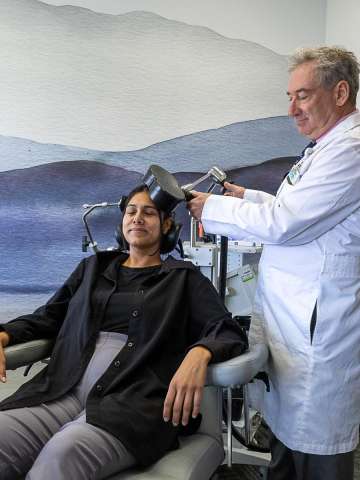
Depression and OCD can be treated in the same TMS course, often targeting different brain regions in a single session.
Bill's Story
Who Is TMS for OCD For?
TMS for OCD is designed for patients who haven't responded adequately to standard treatments, including medication (typically SSRIs) and cognitive-behavioral therapy (CBT) with exposure and response prevention (ERP). If you've tried multiple approaches without sufficient relief, TMS may offer a path forward.
During your initial evaluation, our team will review your treatment history and determine whether TMS is an appropriate option for your specific situation.
What to Expect
The treatment process is similar to TMS for depression: daily sessions, Monday through Friday, over the course of several weeks. Each session involves sitting comfortably while the TMS coil is positioned over your head. You'll feel a tapping sensation on the scalp during stimulation.
There is no anesthesia or sedation, and you can return to your normal activities immediately after each session. A board-certified psychiatrist is present at every treatment to monitor your progress and make any necessary adjustments.
Insurance Coverage
TMS is FDA-cleared for OCD (2018). Whether it's covered depends on your specific plan and diagnosis — our care management team and insurance specialists will review your benefits and guide you. For help, visit our Insurance page or contact our intake coordinators at (310) 825-7471.
Ready to Get Started?
The first step is a referral from your current provider. Our team will evaluate your history and determine the best TMS approach for your OCD.
Call: (310) 825-7471
Email: TMSReferrals@mednet.ucla.edu
References
- Carmi L, Alyagon U, Barnea-Ygael N, Zohar J, Dar R, Zangen A. Clinical and electrophysiological outcomes of deep TMS over the medial prefrontal and anterior cingulate cortices in OCD patients. Am J Psychiatry. 2019;176(11):931-938. PubMed
- Tendler A, Barnea Ygael N, Roth Y, Zangen A. Deep transcranial magnetic stimulation (dTMS) — beyond depression. Expert Rev Med Devices. 2016;13(10):987-1000. PubMed
Medically reviewed by Evan Einstein, MD, MPH · Last reviewed June 2026