
Noninvasive Pain Neuromodulation
Three noninvasive approaches to chronic pain — Scrambler Therapy, mPNS, and TMS for central pain — delivered by one expert neuromodulation team.
Scrambler Therapy
What Is Scrambler Therapy?

Scrambler Therapy (also known as Calmare) is a 510(k)-cleared cutaneous electroanalgesia device that offers a fundamentally different approach to treating chronic neuropathic pain.1,2 Unlike TENS devices and conventional pain treatments that simply block or mask pain signals, Scrambler Therapy works by sending new information to the brain — effectively "retraining" the nervous system to stop perceiving pain.3,4
Cleared by the FDA in 2009 for symptomatic relief of acute and chronic pain, Scrambler Therapy has been most extensively studied for chemotherapy-induced peripheral neuropathy (CIPN), postherpetic neuralgia, complex regional pain syndrome (CRPS), cancer pain, and postsurgical neuropathic pain.5

How It Works
In chronic neuropathic pain, the brain has undergone maladaptive neuroplastic changes, becoming essentially “hardwired” to perceive pain even without active tissue damage. Scrambler Therapy addresses this by delivering dynamically changing signal patterns that the brain cannot adapt to or tune out.
Scrambler Therapy is based on Shannon’s Information Theory rather than the Gate Control Theory used by TENS. The device targets the surface receptors of C-fibers — the slow-transmitting nerve fibers responsible for chronic pain — and sends synthetic “non-pain” or “normal-self” information through them.
Long-Lasting Relief
Over the course of treatment, this process drives neuroplastic remodeling — “retraining” the brain’s pain centers to stop perceiving pain at the treatment site.
This is why the relief from Scrambler Therapy can last weeks, months, or even years after the treatment course is completed — it’s not just blocking a signal, it’s changing how the brain processes information from that part of the body.
Studied Indications
Scrambler Therapy has been studied and shown benefit for the following conditions:1
- Chemotherapy-Induced Peripheral Neuropathy (CIPN): The most widely studied indication, with multiple trials showing improvements in both pain and non-painful sensory symptoms like numbness and tingling
- Postherpetic Neuralgia: Significant pain reduction that can persist for months after the treatment cycle
- Complex Regional Pain Syndrome (CRPS): Promising results in this notoriously challenging pain condition
- Cancer Pain: Effective for bone and visceral metastatic pain
- Postsurgical Neuropathic Pain: Effective for chronic neuropathic pain following surgical procedures
- Spinal Stenosis / Chronic Back Pain: Studied for chronic back pain syndromes
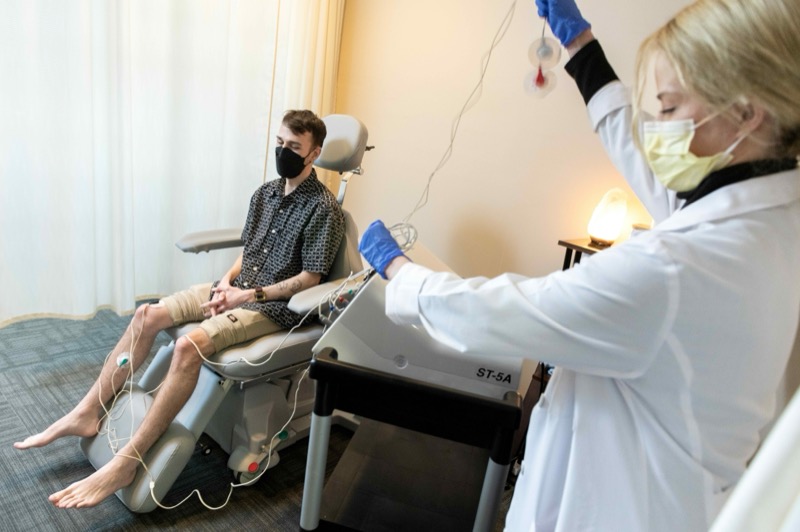
Scrambler vs. TENS: Different Mechanisms, Different Treatments
| Feature | TENS | Scrambler Therapy |
|---|---|---|
| Theoretical Model | Gate Control Theory (block/inhibit pain transmission) | Information Theory ("retrain" CNS via neuroplastic changes) |
| Targeted Fibers | Aβ fibers (fast-transmitting) | C-fiber surface receptors (slow-transmitting) |
| Duration of Relief | Temporary — relief stops when stimulation stops (hours) | Weeks, months, or years after completed treatment cycle |
| Electrode Placement | Can be placed on the pain area | NEVER on painful or numb tissue — placed on healthy skin along the affected dermatome |
Safety
Scrambler Therapy has an excellent safety profile. Contraindications include implanted pacemakers, defibrillators, spinal cord or peripheral nerve stimulators, and uncontrolled epilepsy.
Insurance & Cost
Most insurance plans cover both the physician visit and the procedure. For details on coverage, visit our Insurance page or contact our intake coordinators at (310) 825-7471.
Magnetic Peripheral Nerve Stimulation (mPNS)
What Is mPNS?
Magnetic Peripheral Nerve Stimulation (mPNS) is FDA-cleared for chronic intractable pain, post-traumatic pain, post-surgical pain, and painful diabetic neuropathy (PDN).6,7,8 It works by delivering focused magnetic pulses directly to peripheral nerves, modulating aberrant pain signaling — the same TMS technology we use for brain stimulation, applied to the body rather than the head. We tailor the coil and stimulation to the size and depth of each treatment target.
How It Works
mPNS uses electromagnetic induction to preferentially activate large-diameter sensory nerve fibers (Aβ fibers) at a 9:1 ratio over smaller pain fibers. This has multiple therapeutic effects:
- Spinal gating: Selective activation of sensory fibers blocks pain signal transmission at the spinal cord level
- CNS reconditioning: The treatment generates strong, painless muscle contractions that send proprioceptive input to the brain, promoting neuroplasticity and activating the body's natural descending pain-inhibitory pathways
- Neuronal blockade: At low frequencies, mPNS can temporarily halt pain signal conduction along the targeted nerve fibers
Key Clinical Evidence
Patients with chronic neuropathic pain experienced significant, lasting relief.
Randomized controlled trial in painful diabetic neuropathy.
Treatment Protocols
1. Low-Frequency Protocol (0.5 Hz)
~13 min per session
Neuropathic pain, diabetic neuropathy
2. High-Frequency Protocol (20 Hz)
~10 min per session
Musculoskeletal pain, knee OA, chronic low back pain
Where mPNS Fits in Pain Treatment
A key advantage of mPNS is its position in the treatment algorithm: it is recommended directly after conservative medical management (medications) fails, before invasive procedures such as temporary peripheral nerve stimulators, implanted stimulators, or spinal cord stimulators. This gives patients a noninvasive, low-risk option before committing to surgical interventions.
What to Expect at Your First Visit
At your evaluation, one of our physicians will review your symptoms and medical history, determine whether Scrambler, mPNS, or TMS is appropriate, explain how treatment works, and build a personalized treatment plan with you. There are no procedures at the first visit — just the evaluation.
Call: (310) 825-7471
Email: TMSReferrals@mednet.ucla.edu
References
- Karri J, Marathe A, Smith TJ, Wang EJ. The Use of Scrambler Therapy in Treating Chronic Pain Syndromes: A Systematic Review. Neuromodulation. 2023;26:1499-1509. PubMed
- Jin Y, Kim D, Hur J, Myung SK. Efficacy of Scrambler Therapy for Management of Chronic Pain: A Meta-Analysis of Randomized Controlled Trials. Pain Physician. 2022;25:E931-E939. PubMed
- Smith TJ, Wang EJ, Loprinzi CL. Cutaneous Electroanalgesia for Relief of Chronic and Neuropathic Pain. N Engl J Med. 2023. PubMed
- Marineo G. Inside the Scrambler Therapy, a Noninvasive Treatment of Chronic Neuropathic and Cancer Pain. Integr Cancer Ther. 2019;18:1-17. PubMed
- Majithia N, Smith TJ, Coyne PJ, et al. Scrambler Therapy for the management of chronic pain. Support Care Cancer. 2016;24(6):2807-2814. PubMed
- Bedder M, Parker L. Magnetic Peripheral Nerve Stimulation (mPNS) for Chronic Pain. J Pain Res. 2023;16:2365-2373. PubMed
- Kapural L, Patel J, Rosenberg JC, et al. Safety and Efficacy of Axon Therapy (SEAT Study), Utilizing mPNS for Treatment of Neuropathic Pain. J Pain Res. 2024;17:3167-3174. PubMed
- Brown L, Gage E, Cordner H, et al. Safety and Efficacy of Magnetic Peripheral Nerve Stimulation for Treating Painful Diabetic Neuropathy. Neuromodulation. 2025;28:1366-1373. PubMed
- Kapural L, Patel J, Rosenberg JC, et al. Efficacy and Safety of mPNS for Treatment of Neuropathic Pain; One Year Follow Up. J Pain Res. 2025;18:4471-4481. PubMed
- Mohamed MSI, Alkahlout L, Elgamal S, et al. Efficacy of scrambler therapy in chronic neuropathic pain: pairwise and dose-response meta-analysis. Brain Netw Modul. 2024;3(3):63-70. PubMed
- Wang EJ, Limerick G, D’Souza RS, et al. Safety of Scrambler Therapy: A Systematic Review of Complications and Adverse Effects. Pain Med. 2023;24(3):325-340. PubMed
- Knotkova H, Hamani C, Sivanesan E, et al. Neuromodulation for chronic pain. Lancet. 2021;397:2111-2124. PubMed
Medically reviewed by Evan Einstein, MD, MPH · Last reviewed June 2026